
Stump Grinding and Removal in Maury County, TN
Stump grinding in Maury County starts with one question: will that spot be mowed, or built on? Grinding takes a stump down below the surface so you can mow right over it. Removal digs the stump and its main roots out so something can sit on top. Here's how each one works, what limestone in the stump hole means, why to check with Tennessee 811 before anything digs, which stumps sprout back and which don't, and what stump work costs.
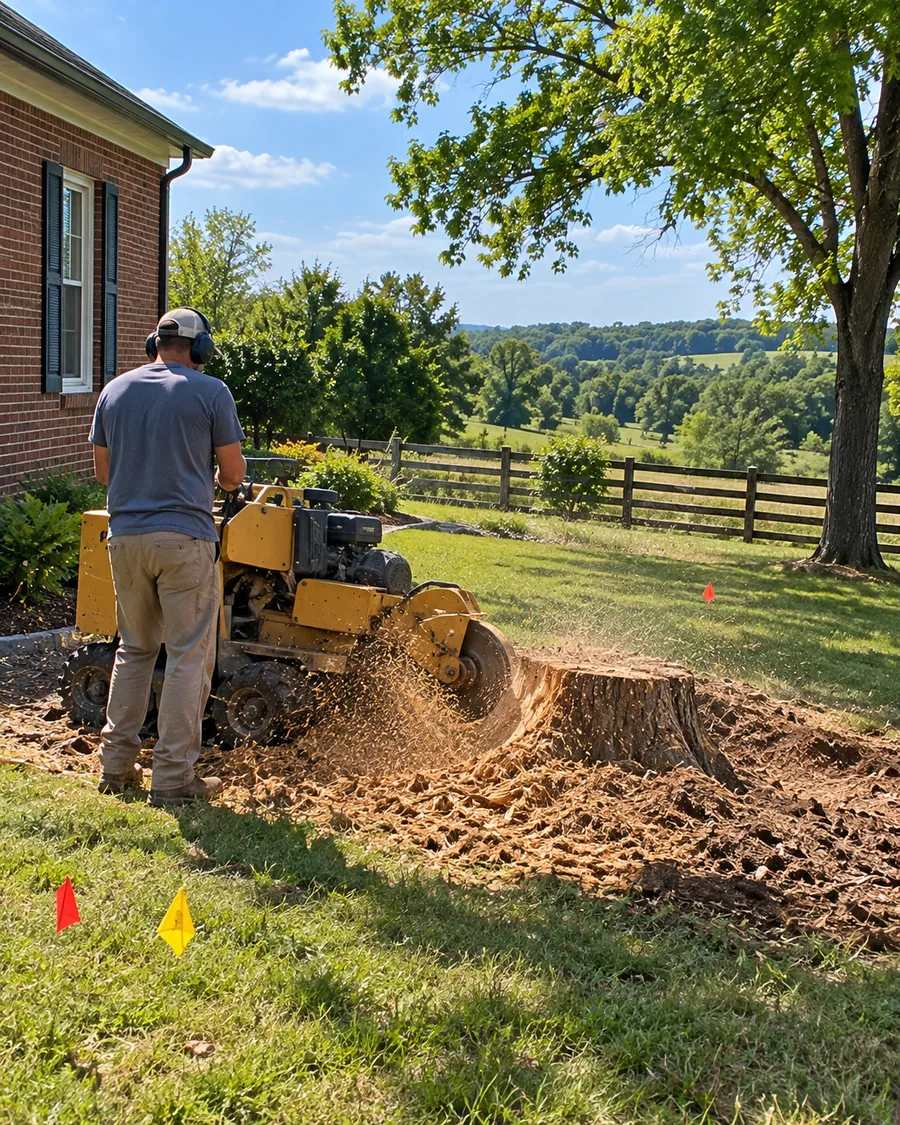
Grinding, for spots you'll mow
A grinder is a heavy wheel ringed with hard teeth. Walk-behind models squeeze through a yard gate, and larger tracked machines take on big stumps out in a field. Swinging the spinning wheel side to side, the operator cuts the stump down into chips past ground level, then rakes chips and loose dirt back over the spot.
Settle the depth before the work starts. Tell the contractor what the spot is for (mowing over it, a lawn, a flower bed) and ask what depth the price includes. The roots stay in the ground either way, and the chips settle as they rot, so the spot may sink over time and need some topsoil. If you want grass there soon, ask to have most of the grindings hauled off and the hole filled with soil.
Removal, for spots you'll build on
To remove a stump outright, an excavator or backhoe lifts it out along with its big roots. The root ball is hauled away, ground, or burned where burning is allowed, and the hole gets backfilled and compacted. Do this under a house, slab, driveway, shop, or septic field: roots left from grinding decay over the years, and the ground above them sinks. Removal costs more per stump and tears up more ground, so it's usually part of clearing a house site rather than a job on its own.
Rock in the stump hole
Maury County's common soils are a thin silt loam over sticky reddish-brown clay, mixed with whitish chert gravel and flat limestone slabs, with rock ledges often close to the surface. Roots grow around that rock. When a stump is pulled here, chunks of limestone can come up tangled in the root ball and leave a ragged, rocky hole. When a stump is ground, the teeth can hit stone that's hidden in the roots, which chips them and slows the work. Tell the contractor if you know a stump sits on rock, and ask how the price handles it.
Cedar stumps, and stumps that sprout
Cedar stumps are the easy ones: they won't come back. The U.S. Forest Service's redcedar review says it "does not sprout after complete cutting or burning." A cedar stump at a field edge can simply be left to rot if it's not in the way of a mower. Privet and bush honeysuckle are different: both sprout from the root crown after they're cut, per the Forest Service reviews of privet and honeysuckle. Grinding takes out the crown, but privet can still sucker from shallow roots left in the ground. Brush and invasive thickets covers that follow-up.
Check with Tennessee 811 before anything digs
Tennessee's damage prevention rules treat "movement, placement, or removal of earth, rock, or other materials in or on the ground" by machine or by hand as excavation, and Tennessee 811's FAQ says the requirement "is for both professional excavators and homeowners/private property owners." Digging a stump out with an excavator is clearly covered. Stump grinding isn't named either way, so ask. Tennessee 811 says to call 800-351-1111 with questions about a specific project, or dial 811 to file a ticket.
- Notice is due at least three, and not more than ten, working days before the work. The request is free.
- Utilities have three business days to mark, and a ticket is good for 15 calendar days after the legal start date.
- A homeowner's ticket doesn't cover a hired excavator. Whoever digs needs their own.
- Private lines, like a well line to the house or power run out to a barn, may not be marked. Point them out yourself.
- Penalties can reach $15,000 per incident.
What stump grinding costs
HomeAdvisor's June 2026 guide gives $250 as the average, with most jobs between $120 and $500. By its figures, pros bill $2 to $5 for each inch of diameter, a lone stump often carries a $100 to $150 minimum, and every stump after the first can run as little as $40 to $75.
Run the numbers and the minimum often decides it. A 24-inch stump at $2 to $5 an inch comes to $48 to $120, which is at or under that minimum. Five stumps, using HomeAdvisor's figures, would be the first at $100 to $150 plus four more at $40 to $75 each, or $260 to $450 in all. Rock, big hardwood stumps, hard-to-reach spots, hauling the grindings, and digging stumps out instead of grinding all push the number up. All of this is national pricing, not a Maury County rate card; the price that matters is the one written down after someone looks at your stumps. See the cost guide.
Who grinds stumps, and licensing
Tree services, land clearing contractors, and stump-grinding specialists all do this work. Tennessee requires a contractor license "whenever the total cost of the project is $25,000 or more," and its classification outline has no classification just for stump removal. Stump work almost never costs that much, so the thing to check is liability coverage, since a grinder flings debris and can strike a buried cable. Our hiring guide has more questions worth asking.
Questions about stumps
Is it okay to leave a stump where it is?
A cedar stump at the edge of a field, sure; it won't sprout. In a yard it's a mower hazard, and privet or honeysuckle stumps will send up sprouts. Grind the ones in the way.
Can I plant a new tree in the same spot?
Better to move over a few feet. The old roots are still down there and the ground stays loose while the grindings rot. If it has to be the same spot, have the grindings removed and the hole filled with soil.
How long does it take?
Grinding a single stump doesn't take long once the machine is in place. Rock slows it. Allow for the 811 wait, too, since utilities have three business days to mark.
Is a permit required?
A handful of yard stumps, no. Pulling a lot of stumps for a building project counts as land disturbance, and at an acre or more it falls under TDEC's construction permit; inside Columbia, Mount Pleasant, and Spring Hill, city rules apply too. The permits guide explains.
How we help
Tell us how many stumps there are, about how wide, and what you want each spot for. We'll send that to one independent contractor who handles stumps near you, who will look them over and price the job. You decide from there. There's no charge for the referral.
Want a local contractor to walk your land?
Call or send a short request. There's no charge for the referral.