
Cedar Clearing in Maury County, TN
If you own pasture around Columbia, Mount Pleasant, or anywhere in rural Maury County, you've watched eastern redcedar move in: along the fence rows, across a hay field that missed a few mowings, then thick on every rocky knob. Cut completely, cedar doesn't come back from the stump. Here's how cedar gets cleared, why it doesn't come back from the stump, what limestone does to the work, what it costs, and what to do with the piles.
Why cedar keeps taking over pasture
Eastern redcedar is the only common conifer in most of Maury County's farm country, and it grows scattered on rocky ground, in fence rows, and in old fields. An idle field here typically goes to broomsedge and sumac first, then to redcedar and black locust.
The U.S. Forest Service's species review for eastern redcedar lists "abandoned pastures and cultivated fields" among the places it moves in: "In as little as 30 years after a fire, a treeless pasture can be converted to a closed canopy eastern redcedar forest." That matters in a county with nearly 75,000 acres of pasture and about 38,700 cattle and calves (2022 Census of Agriculture). In winter, with the hardwoods bare, the cedars and bush honeysuckle are about the only green left in the fence rows.
Cut it completely and it stays gone
Here's the good news. Chinese privet and bush honeysuckle sprout back after they're cut; redcedar doesn't. The same Forest Service review says it "does not sprout after complete cutting or burning" and that "there is no natural asexual reproduction in eastern redcedar." A cedar cut off at the ground, or ground up by a mulcher, is dead. New cedars come only from seed. That changes the plan:
- Take the whole tree. The no-sprout rule is about complete cutting. Limbing a cedar up or topping it isn't the same thing.
- Cedar stumps don't need herbicide to keep them from sprouting. The privet and honeysuckle mixed in with them are another story; see brush and invasive thickets.
- Follow-up is about seedlings. Regular mowing or bush hogging in the years after clearing keeps new cedars from getting a start.
- Fire is for upkeep, not clearing. The review says spring burns usually kill cedars up to about 3.3 feet tall. That takes planning and a permit; the Division of Forestry's Find a Forester page lists who to ask.
Mulching, or cutting and piling
Two methods cover most cedar jobs, and plenty of jobs use both.
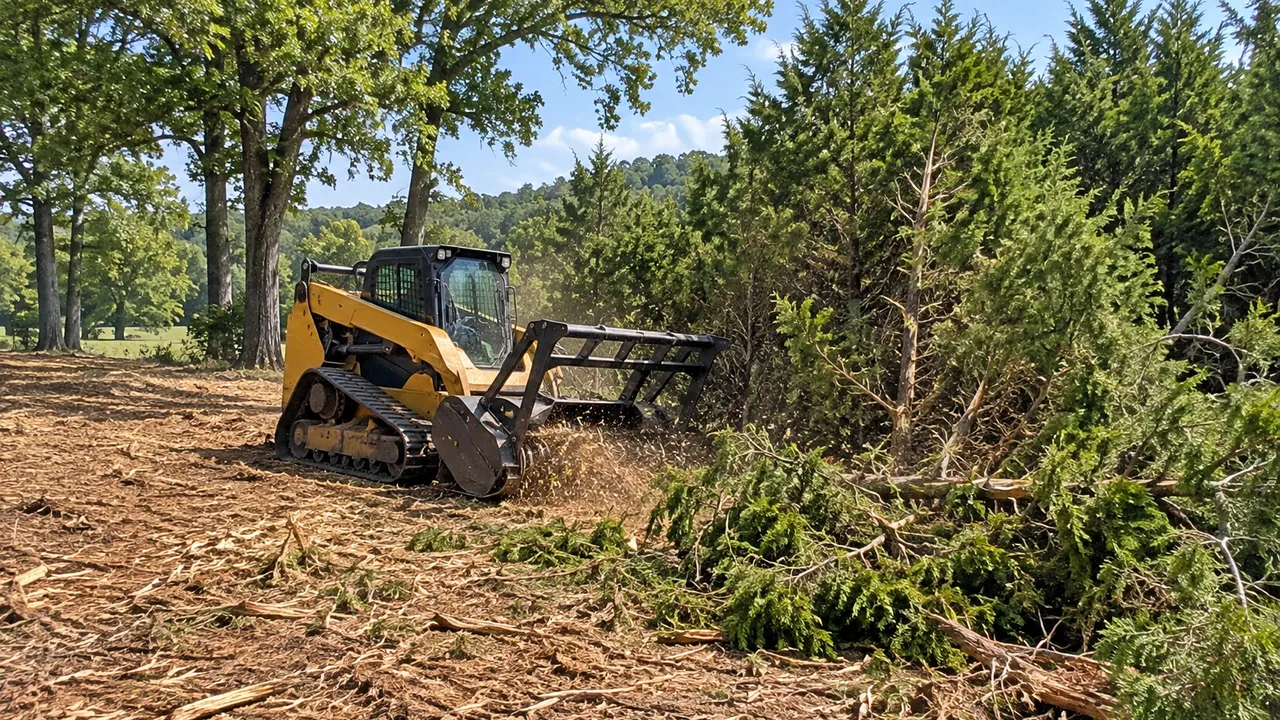
- Forestry mulching. A toothed drum on a tracked machine grinds standing cedars into red mulch. Nothing to pile, burn, or haul, the roots hold thin soil on slopes, and the operator can work around keepers. It fits fence rows, pasture edges, and young to medium cedar.
- Cut, push, and pile. Bigger cedars are cut, then an excavator or dozer pushes them into piles that are burned in season, left to rot, or hauled. It leaves open ground ready to work, but the piles have to go somewhere, and pushing trees out drags up soil and rock.
Where a house, barn, or driveway will go, neither one is enough by itself. Stumps and roots under a pad have to be dug out; clearing a house site covers that.
Rock is what slows cedar jobs here
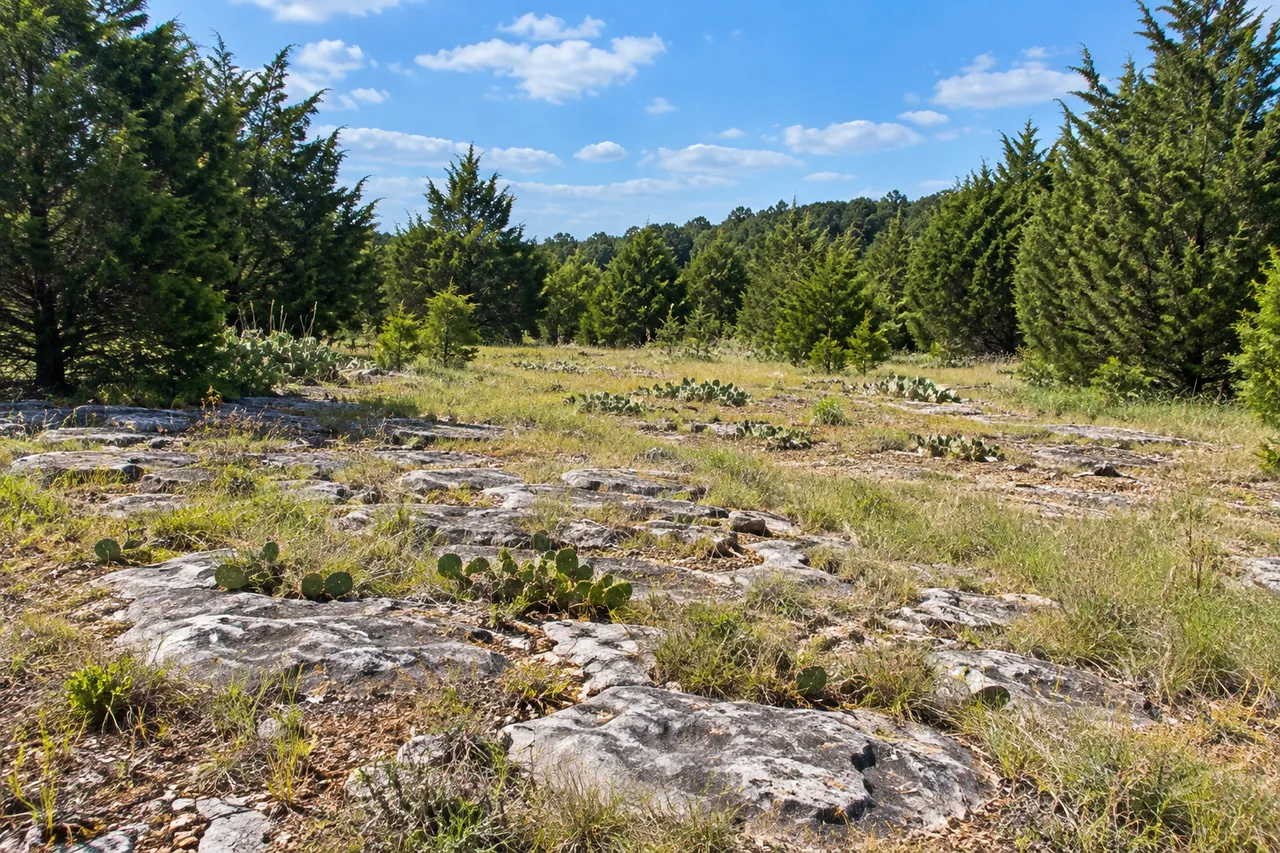
Cedar thrives on exactly the ground a machine likes least. Around Columbia the land is rolling limestone country, and the rock shows: flat gray ledges and slabs in the pastures, and open cedar glades of bare rock with patchy grass, lichens, and prickly pear. Common upland soils such as Maury, Mimosa, and Talbott are a thin silt loam over sticky reddish-brown clay, with chert gravel and limestone slabs mixed in and rock ledges often close to the surface. Toward Mount Pleasant and Hampshire, the Highland Rim hills are gravelly and full of chert.
- Mulcher teeth meet rock. They chip and wear, and a careful operator lifts the head over ledges, which is slower than open ground. Ask how the quote handles rocky ground.
- Clearing doesn't add soil. A cleared glade is still rock and thin soil, so set expectations for what it will grow.
What to leave standing
- Cover along creeks. Even on farm ground, TWRA's voluntary guidance on buffers for streams and sinkholes recommends bands of permanent vegetation, typically 20 to 180 feet wide.
- Sinkholes. Don't push cedar or fill into one. TDEC regulates a sinkhole as an injection well when development changes the water flowing into it. Ask the TDEC Columbia Environmental Field Office, (931) 380-3371, before working in or around one.
What cedar clearing costs
HomeAdvisor's June 2026 guide puts forestry mulching at $400 to $1,500 per acre, and heavy, dense brush at $200 to $400 an hour. Angi's May 2026 guide puts mulching at $1,000 to $2,500 per acre or $150 to $300 an hour. For conventional clearing, Angi's September 2026 figures put a densely forested acre at $3,600 to $5,600. These are national figures, not Maury County prices, and a closed stand of cedar on rock shouldn't be expected to land at the low end.
To see how hourly pricing adds up: if a contractor expects one 8-hour day of mulching on an acre of thick cedar, HomeAdvisor's $200 to $400 hourly range comes to $1,600 to $3,200 for that day. The day is the assumption. Stem size and count, rock, slope, and whether trees are mulched or piled move the real number, and the written quote from a contractor who has seen your cedar is the number that counts. More on cost.
Burning cedar piles
If the cedar is cut and piled, the rules depend on where the land is. In rural Maury County, from October 15 through May 15, state law requires a free Division of Forestry burn permit for any open-air fire within 500 feet of a forest, grassland, or woodland, and larger land-clearing burns go through the phone line, 877-350-2876. Columbia allows land-clearing fires only for agricultural, forest, or game management purposes, with a free city permit (931-560-1700). Mount Pleasant requires a permit from its fire department, (931) 379-3939. Its burn page doesn't cover land-clearing fires, and the council took up changes to the burning ordinance in July 2026, so ask when you call. Spring Hill's burn pages say "Land clearing fires are prohibited." Check the burn ban dashboard before lighting anything; the permits guide has the full rules.
Help paying for it
NRCS's Brush Management practice (code 314) covers removing woody plants, and one of its stated purposes is to "improve forage accessibility, quality, and quantity for livestock and wildlife." Funding runs through EQIP, whose Tennessee page shows an apply-by date of November 20, 2026. The first step is the local NRCS office: the USDA Service Center in Columbia, 931-388-1307, ext. 3 (call before going). Talk to them before clearing starts.
Cedar clearing questions
Will the cedars come back?
Not from the stumps. Mow or bush hog to keep new seedlings down, and plan on sprouts from any privet or honeysuckle cut along with the cedar.
Will the mulch hurt my pasture?
A thick layer slows reseeding until it breaks down or is raked off, because seed has to reach the soil. UT Extension in Columbia (931-375-5301) can help with a plan for getting grass back.
Can the cedar be cleared and the big oaks kept?
Yes. Flag the oaks, hickories, and walnuts you want kept, and walk the line with the contractor before the machine starts.
Do I need a permit to clear cedar from pasture?
Tennessee's water rules treat farm clearing differently from construction. Steep ground, creeks, sinkholes, and burning have rules of their own, and Building & Zoning (931-375-3002) can confirm what applies in the county. The permits guide has the details.
How we help
Call or send a short request with where the land is, roughly how many acres, and how thick the cedar is. We connect you with one independent contractor who clears cedar in your part of Maury County. They walk the land and give you a quote, and you decide. There's no charge for the referral.
Want a local contractor to walk your land?
Call or send a short request. There's no charge for the referral.