
Forestry Mulching in Maury County, TN
Forestry mulching clears cedar, privet, and brush off Maury County pasture edges, fence rows, and woods without leaving a single pile to burn. One tracked machine grinds standing growth into mulch right where it stands, the roots stay in the thin soil over the rock, and the trees you want to keep stay up. Here's how it works on cedar and limestone, where it fits and where it doesn't, what grows back, what it costs, and the permit questions worth asking first.
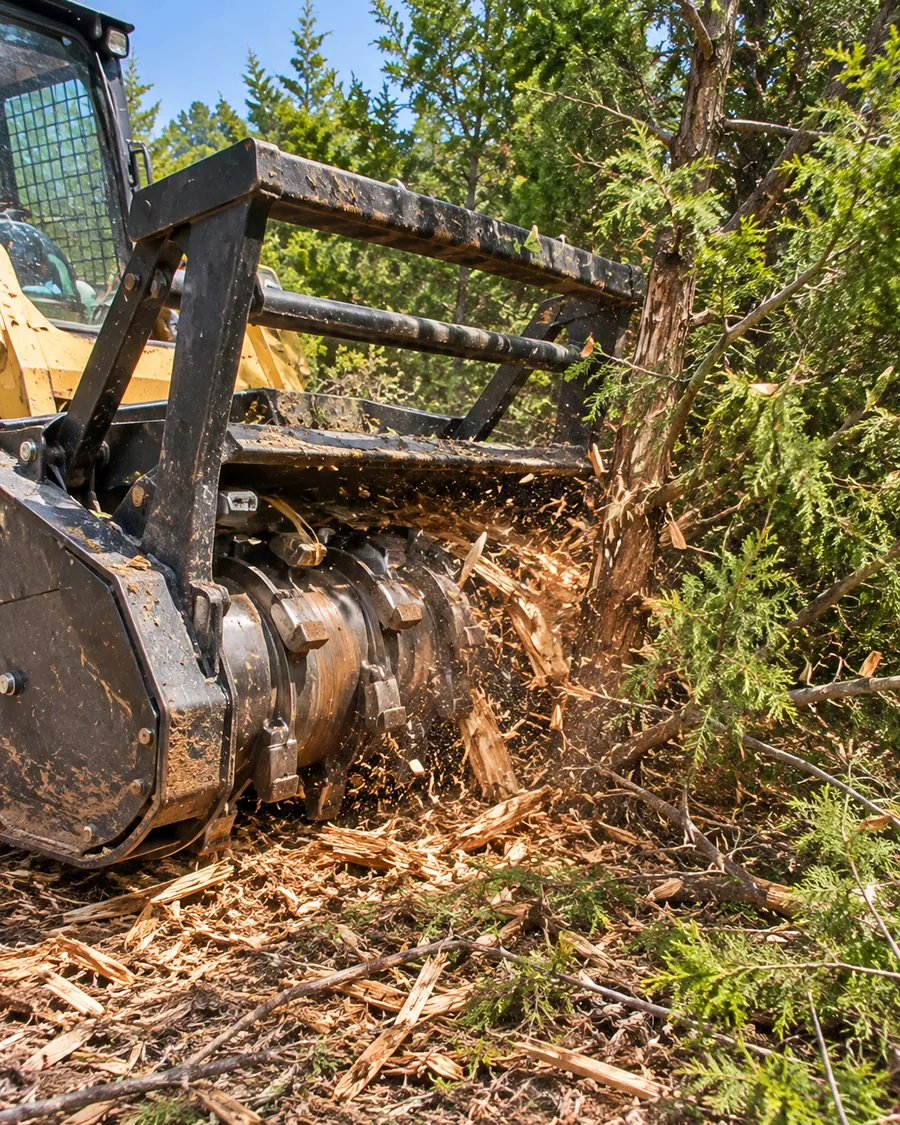
How a forestry mulcher works
The working part is a spinning drum or disc studded with steel or carbide teeth, mounted on anything from a skid steer or tracked loader to an excavator boom or a dedicated mulching tractor. Driven into standing cedar or brush, the head chews it down from the top and drops the chips in place as a mat of mulch. There's no saw crew working ahead, no piles, no chipper, and no trucks hauling brush away: one person and one machine.
Heads come in different sizes, and the biggest stem a machine handles comfortably varies with the head and the carrier behind it. Ask each contractor what their setup takes. Trees beyond that get cut with a saw and fed to the head in pieces, or that part of the job becomes conventional clearing.
On cedar and limestone
Maury County gives a mulcher two things to deal with at once: thick cedar and rock close to the surface. The county's common upland soils are a thin silt loam over sticky reddish-brown clay, with whitish chert gravel and flat limestone slabs mixed in and rock ledges often close to the surface. In the open glades the limestone is bare. On the Highland Rim hills toward Mount Pleasant and Hampshire, the ground is paler, gravelly, and full of chert.
- Teeth wear. Every time the head touches stone, teeth chip or dull. On ledge ground, a careful operator holds the head a little higher rather than grinding rock, so ask how low they'll cut on your land and how the price allows for rocky ground.
- Slopes slow things. Steep hillsides on the Rim take more care than rolling pasture.
- Sinkholes stay off limits. Machines shouldn't drive into them, and mulch shouldn't be pushed into them. TDEC treats a sinkhole whose drainage is changed by development as a regulated injection well.
- Cedar stays dead. The U.S. Forest Service's redcedar review says it "does not sprout after complete cutting or burning," so a mulched cedar won't come back from the stump. More on that in cedar clearing.
Where mulching fits in Maury County
- Opening up fence rows and pasture edges grown up in cedar, hackberry, and privet.
- Taking cedar back off pasture, hay ground, and glades.
- Clearing the privet and bush honeysuckle understory out of a woodlot while leaving the oaks, hickories, and walnuts.
- Trails, lanes, shooting lanes, and food plots on hunting land.
- Knocking down most of a wooded homesite before only the footprint is dug out.
- Firebreaks along woods and around barns.
When it's the wrong tool
- Anywhere you'll build. Roots left behind rot and settle. Under a house pad, driveway, barn, or septic field, the stumps and roots need to come out. Mulch the acreage; dig out the footprint.
- Real timber. Big hardwoods can be more than a mulching head should take on, and a good stand may be worth selling first. The Division of Forestry's Find a Forester page lists who to ask about a timber sale.
- In or right beside a creek. Work that changes a stream channel needs a state permit, and construction projects keep an undisturbed buffer along streams. See the permits guide.
- When you need bare dirt now. Seed has to reach soil, so a thick mulch layer slows reseeding until it breaks down or is raked off.
What grows back
A mulcher cuts plants off; it doesn't dig out roots. That's fine for cedar, which doesn't resprout. It's not fine for Chinese privet and bush honeysuckle. The Forest Service's privet review says cutting without herbicide "will likely promote growth from sprouting," and its honeysuckle review says the plant sprouts from the root crown after its stems are damaged. Where the brush was mostly privet and honeysuckle, plan on mowing the sprouts, spot-treating them, or both in the first year or two. Ask whether the contractor treats stumps as they go, and ask UT Extension in Columbia (931-375-5301) about herbicides near pasture. Brush and invasive thickets covers follow-up in more detail.
Mulching prices, and how they add up
Contractors price mulching by the acre, by the day, or by the hour of machine time. HomeAdvisor's June 2026 guide puts it at $400 to $1,500 per acre. Its hourly rates climb with density: $200 to $400 for heavy, dense brush, $150 to $300 when grading is included, and $125 to $200 for lighter underbrush and small trees. Angi's May 2026 guide puts it at $150 to $300 an hour or $1,000 to $2,500 per acre, with most homeowners spending $1,000 to $4,000 on a standard project.
To see how hourly pricing works: a half day (4 hours) on light underbrush at HomeAdvisor's $125 to $200 comes to $500 to $800, before any minimum or trip charge the contractor has. The hours are an assumption for the example. Closed cedar on rock, steep Rim ground, and a lot of privet to treat are the things that push a Maury County job up, so don't count on the low end of these ranges. Treat every figure here as a national benchmark, not a Maury County price; what you'll actually pay is whatever the contractor writes down after seeing the ground. The cost guide goes further.
Permits for a mulching job
What matters most is the purpose of the clearing. TDEC's Construction General Permit covers construction sites "involving clearing, grading or excavation that result in an area of disturbance of one or more acres." Nothing official we found says whether mulching that leaves the roots in counts as disturbance, so if the mulching is part of building something on an acre or more, ask the TDEC Columbia Environmental Field Office, (931) 380-3371, first. Clearing for farming or forestry is treated differently: a TDEC and NRCS fact sheet says the state's water law doesn't apply to "any agricultural or forestry activity" unless there's a point source discharge. Inside Columbia, the city's Land Disturbance Permit starts at one acre for development and exempts agricultural land management under USDA rules. Inside Columbia, removing trees on anything other than a single-family lot of an acre or less generally needs an approved plan or permit under the city's tree protection rules; ask Development Services, 931-560-1560. The permits guide has the rest.
Forestry mulching questions
Should I cut the trees down before the mulcher comes?
Usually not. Mulchers are built to work standing growth, and trunks lying in every direction slow them down. Ask the contractor before you pick up a saw.
How low will it cut on rocky ground?
That depends on the rock. Where limestone is at the surface, expect the operator to stay above it. If you'll mow the area afterward, say so, and ask what height to expect.
Can it work around my fence and the trees I'm keeping?
Yes, with a careful operator. Flag the keepers, point out wire and rock walls, and agree how close the head will go. Right against wire, some of it may be saw work.
How many acres can be done in a day?
It depends on how thick the growth is, how big the stems are, the rock, and the slope. Light brush on open pasture goes far faster than a closed cedar stand on a ledgy hillside. Ask for an estimate in machine days.
How we help
Tell us where the land is, about how many acres, and whether it's cedar, privet, or mixed brush. We'll pass that to one independent contractor with a mulcher who covers that end of the county. After walking it, they quote you directly, and the choice is yours. There's no charge for the referral.
Want a local contractor to walk your land?
Call or send a short request. There's no charge for the referral.