
Land Clearing Permits, Sinkholes & Burn Rules in Maury County, TN
Do you need a permit to clear land in Maury County? It depends on two things: what the clearing is for, and where the land sits. Farm clearing is treated differently from building. The county has steep slope rules, Columbia, Mount Pleasant, and Spring Hill each add their own, and this is limestone country, so sinkholes and creeks carry state rules of their own. Burning has a state season and three different city policies. Here's each rule with its threshold, the office that decides, and a phone number. Everything here was checked against state, county, and city sources in October 2026. Ordinances get amended, so follow the links before you rely on any of it.
The short version
| If you're... | Then... |
|---|---|
| Clearing or grading for construction on one acre or more | TDEC Construction General Permit coverage, plus the city permit if you're in Columbia, Mount Pleasant, or Spring Hill. |
| Clearing slopes over 15 percent in the county | County steep slope standards: an engineered site plan for 15 to 25 percent inside a building envelope, and no clearing over 25 percent except trails, driveways, and minor utilities. |
| Subdividing land | No clearing or grading until the preliminary plat and construction drawings are approved. |
| Inside Columbia | Land Disturbance Permit at one acre or 10,000 sq ft of new hard surface; tree protection outside single-family lots of an acre or less. |
| Clearing for farming | Generally outside the state's water permits unless there's a point source discharge. Barns, ponds, houses, and roads disturbing an acre still need the construction permit. |
| Working near a creek | Construction sites keep a 30-foot average buffer, 60 feet on Exceptional Tennessee Waters. Work in the channel needs an ARAP. |
| Near or in a sinkhole | Don't fill it or change the water flowing into it before asking TDEC. It may be a regulated injection well. |
| Burning the debris | Free state permit October 15 to May 15 within 500 feet of woods or grassland; in Columbia, land-clearing fires only for farm, forest, or game management, with a city permit; in Mount Pleasant, a fire department permit (ask about land clearing); no land clearing fires in Spring Hill. |
| Building on septic | TDEC site evaluation first. Mark the lines and house site and mow or bush hog; no soil disturbance, cutting, or filling before it. |
| Digging, grading, or pulling stumps | Tennessee 811 ticket, three to ten working days ahead. |
First question: farm work or construction?
A TDEC and NRCS fact sheet explains that Tennessee's water law doesn't apply to "any agricultural or forestry activity" unless there's "a point source discharge from a discernable, confined, and discrete water conveyance," and that "disturbance of soil for the purpose of crop production is exempt from permit requirements." The state's ARAP rules (Rule 0400-40-07-.02) likewise exempt "agriculture and forestry activities." The catch: structures "that disturb one acre or more of soil" (barns, ponds, houses, and roads other than access roads) are treated as construction and need permit coverage even on a farm. And TDEC's ARAP page notes that some conservation practices on farmland may still need coverage. The county's steep slope standards don't list a farm exemption that we found, so if you're clearing cedar or fence rows on steep ground, ask Building & Zoning.
Clearing and grading
The state permit. TDEC's Construction General Permit covers "construction sites involving clearing, grading or excavation that result in an area of disturbance of one or more acres," and smaller sites that are part of a larger common plan of development. TDEC's page says the 2021 permit was set to expire September 30, 2026, with October 1, 2026 as the planned effective date of a new permit, so confirm which permit applies when you file. Coverage starts with a Notice of Intent filed through MyTDEC Forms. TDEC's page lists application fees from $250 (1 to under 5 acres) up to $10,000 (150 acres or more), but doesn't say whether that schedule belongs to the 2026 permit, so confirm the fee. TDEC Columbia Environmental Field Office: (931) 380-3371.
Unincorporated Maury County. The subdivision regulations (revised effective November 24, 2025) say that before final approval of a preliminary plat and construction drawings, "no clearing of trees (with the exception of those required to facilitate surveying activities) or site grading in any form shall be undertaken." The zoning ordinance (effective January 1, 2026) adds Section 5.6, Steep Slope Standards, for "all land disturbing activity and development activities" on steep slopes, hilltops, and ridgetops:
- Slopes of 15 to 25 percent inside a building envelope need "an engineered site plan," and roads and driveways should follow the contour as far as practicable.
- On slopes over 25 percent, "land disturbing activities, including but not limited to clearing, excavation, grading, construction" are prohibited, except non-motorized trails, and driveways and minor utilities. On slopes of 25 to 50 percent, driveways and minor utilities need a geotechnical study, and no driveway or minor utility may cross a slope over 50 percent.
- Isolated steep areas under 10,000 square feet are exempt. Hilltops and ridgetops (flat tops at least 200 feet wide surrounded by steep slopes) have their own open-space rule where open space is required.
Whether the county wants a separate grading permit for an ordinary lot is a question for Maury County Building & Zoning, 5 Public Square in Columbia, 931-375-3002. Ask before the machine arrives.
Columbia. The city's stormwater regulations (adopted September 12, 2024) require a Land Disturbance Permit for development disturbing one acre or more (less if part of a larger plan) or adding "ten thousand (10,000) square feet or more of additional impervious surface," and the City Engineer can require one for some smaller sites. Agricultural land management activities subject to USDA regulations are exempt. Per the engineering fee schedule, the fee is $500 plus $200 per acre for site plan review and inspection ($500 plus $25 per acre for a mass grading permit), non-refundable. Columbia's zoning ordinance also protects trees: except on a single-family lot of an acre or less, existing trees "shall not be removed or disturbed" unless under an approved plan, plat, building permit, or grading permit, with canopy-retention and specimen-tree rules. The ordinance exempts tree removal for agricultural uses from part of these rules; ask Development Services, 931-560-1560, before clearing.
Mount Pleasant. The city has posted a stormwater ordinance (Ord. 2026-1143) with these thresholds: under 10,000 square feet, no Land Disturbance Permit except in certain cases; 10,000 square feet to just under an acre, a permit and a stormwater plan; an acre or more, both plus state permit coverage. It lists karst features as a trigger for a plan and sets civil penalties of $50 to $5,000 per day. The posted copy shows no adoption date, so confirm the current rule with City Hall at (931) 379-7717. The city's application packet asks for a copy of the state permit when an acre or more is disturbed.
Spring Hill. The city's land disturbance application says "The grading permit includes one water test within the Fee Total ($100.00)." It doesn't say how much ground triggers the permit, so ask Development Services at (931) 451-0904 before you clear.
Creeks, buffers, and the Duck River
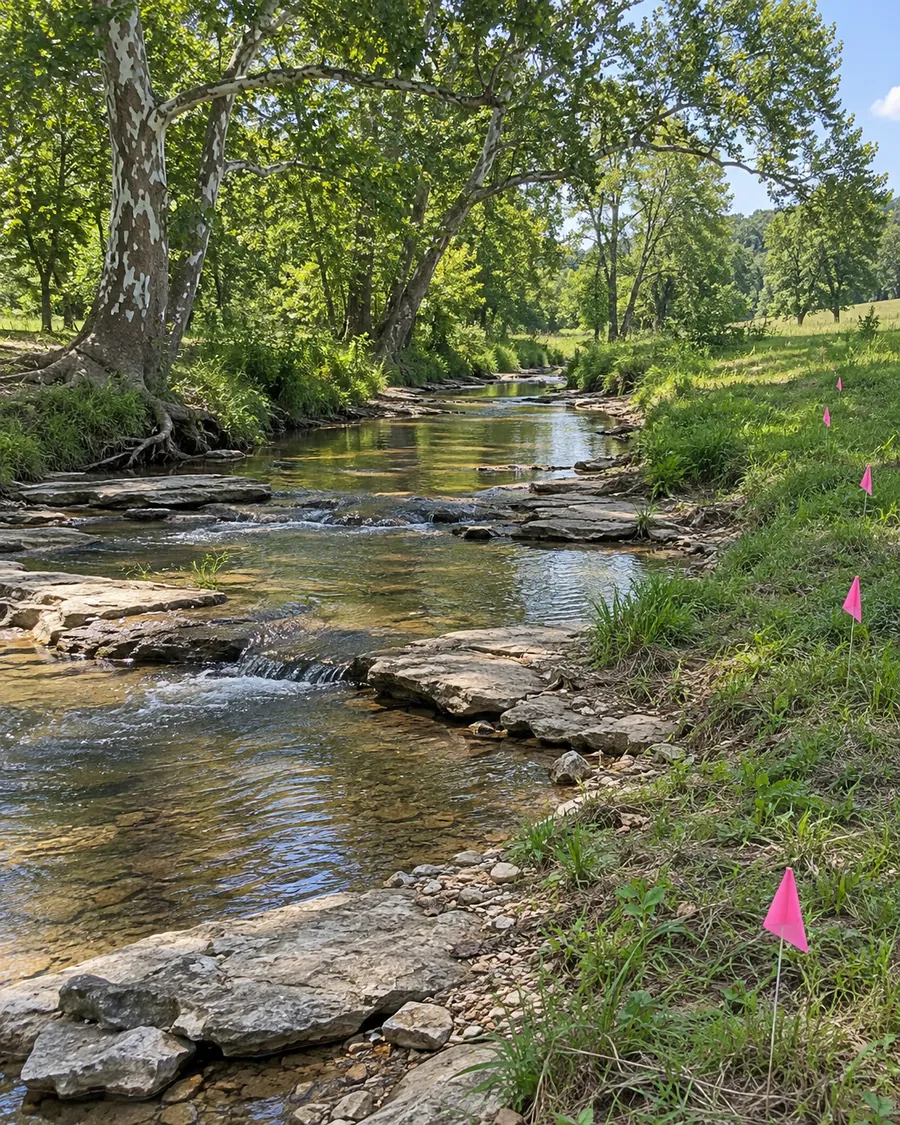
Buffers on construction sites. TDEC's erosion control handbook (January 2026) says the permit "requires preserved buffers to have an average width of 30 feet" "with a minimum of 15 feet at any given location," measured between the water and the limits of disturbance. Exceptional Tennessee Waters and waters impaired for siltation need "60 feet of undisturbed vegetation on average" "with a minimum width of 30 feet."
The Duck River. Two stretches of the Duck in Maury County are state scenic river segments (Class II Pastoral): from Iron Bridge Road (river mile 136.4) upstream to the Maury-Marshall county line (mile 173.7), designated in 2001, and from Industrial Park Road (about mile 128) downstream to the Hickman County line (about mile 98), designated in 2023. Under TDEC rules (0400-40-03-.06), state scenic rivers are Exceptional Tennessee Waters, so construction along those segments falls under the 60-foot buffer. Whether a particular tributary is an Exceptional Tennessee Water or impaired is a question for the Columbia field office.
Work in the water. "Physical alterations to properties of waters of the state require an Aquatic Resource Alteration Permit," TDEC says, including excavation, bank work, crossings, and "flooding, excavating, draining and/or filling a wetland." General permits cost $500 when a Notice of Coverage is required and nothing when it isn't; individual permits cost $2,500 or $5,000 depending on impact points and mitigation, and TDEC lists "$50 for a personal residence or family farm." Federal waters also involve the Army Corps of Engineers, Nashville District Regulatory, (615) 369-7500.
City buffers. Spring Hill's buffer policy keeps a 30-foot natural buffer along streams at construction sites (60 feet on Exceptional Tennessee Waters), 30 feet around ponds, lakes, and wetlands, and adds 10 feet on 15 to 24 percent slopes and 20 feet on steeper ones; and clearing in the buffer needs approval from the city's Storm Water Coordinator. That's the 2019 policy, and the city has since posted a 2023 update, so confirm current widths with Spring Hill's stormwater office, (931) 329-4836. Columbia points to its Engineering Standards for buffer widths (ask Development Services), and Mount Pleasant's packet says to provide buffers "as required by the stormwater ordinance."
Floodplain. The county zoning ordinance has floodplain standards and a floodplain overlay district, and subdivision plats must note the FEMA flood map panel. Before grading or filling low ground, ask Building & Zoning (931-375-3002) or, in Columbia, Development Services.
Sinkholes and karst
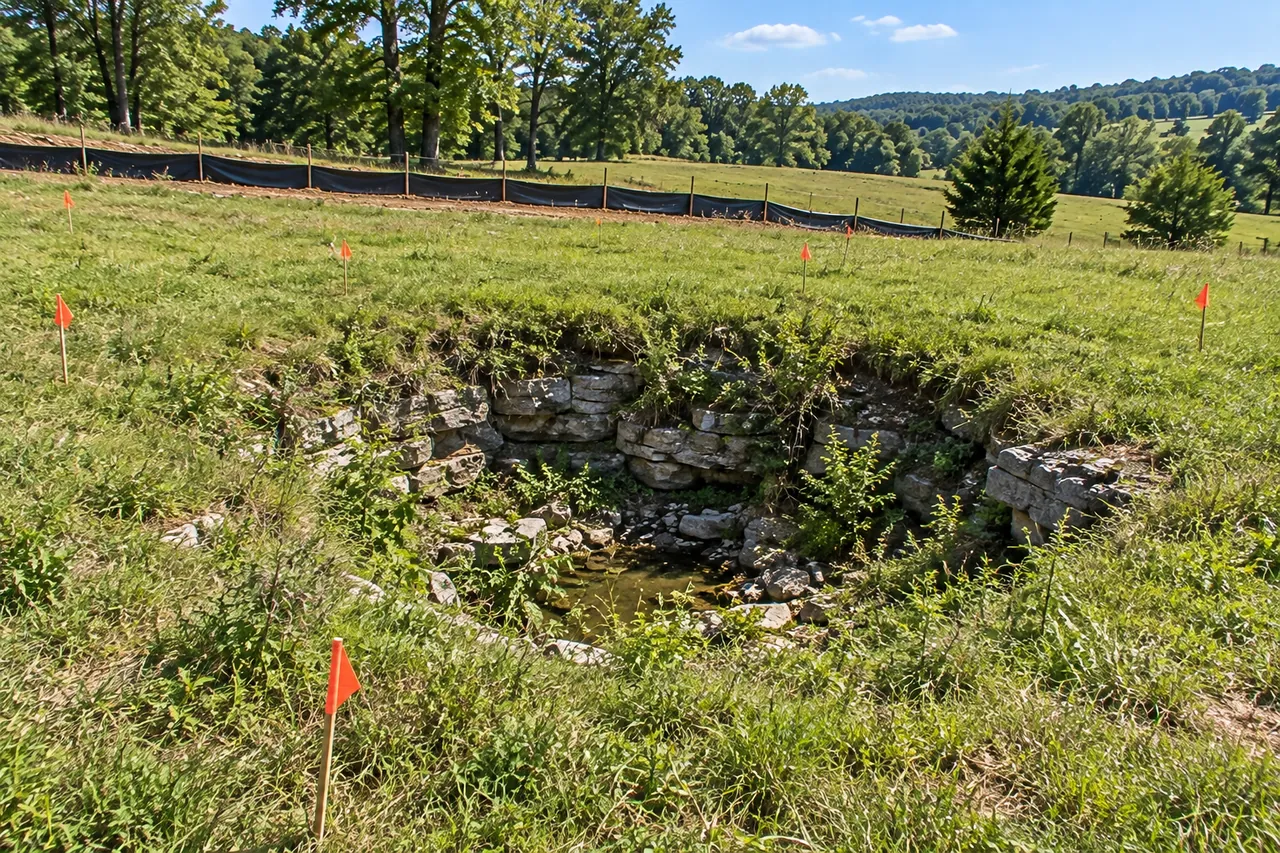
TDEC's guidance on karst and stormwater (effective December 8, 2017) is the document that matters most here. An "improved sinkhole" is a natural depression "modified by man" so that the water entering the ground is altered. A sinkhole is regulated as a Class V injection well when it's on property "developed in a manner that will cause water flowing to the sinkhole to be altered," or when it takes water from offsite, and injection wells are prohibited "unless authorized by an injection well permit or by rule of the Commissioner." Plugging or filling a sinkhole that isn't otherwise regulated doesn't need that authorization, but polluting groundwater is unlawful either way.
- Columbia's stormwater regulations define an improved sinkhole the same way, and Mount Pleasant's posted ordinance lists karst features as a trigger for an erosion control and stormwater plan.
- The county requires sinkholes on concept plans, and on preliminary plats where there's no public sewer or water.
- TWRA's voluntary buffer guidance recommends permanent vegetation around "sinkholes and sinkhole basins," typically 20 to 180 feet wide.
- We didn't find whether filling or altering a sinkhole needs an ARAP. Before any work in or near one, call the TDEC Columbia Environmental Field Office, 1421 Hampshire Pike, (931) 380-3371.
Burning
The state season. "From October 15 through May 15," anyone starting an open-air fire within 500 feet of a forest, grassland, or woodland "must by law secure a burning permit" from the Division of Forestry (permit page). Permits are free. Online permits, for leaf and brush burn piles of any size, are available daily from 8 a.m. to 11 p.m.; by phone, call 877-350-2876, Monday through Friday, 8 a.m. to 4:30 p.m. Central. Larger forestry, agricultural, or land-clearing burns go through the phone process to the county's Division of Forestry office. Permits aren't issued when burning is unsafe, fires must be out when the permit expires, and when burning wooded land you should "let adjacent landowners know of your plans to burn at least 2 days in advance." City burning rules can supersede the state program.
Burn bans. The Commissioner of Agriculture issues them at a county mayor's request. A ban covers brush, debris, and burn barrels, and a violation is a Class A misdemeanor (a $2,500 fine and/or up to 11 months, 29 days in jail). Check the burn ban dashboard the day you burn.
What can burn. TDEC's open burning page says it may be okay to burn branches, tree limbs, woody vegetation, and clean, untreated wood, but never tires, plastics, vinyl, shingles, asbestos, trash, or "most vegetation not grown on site," with fines up to $25,000. Burning wood waste within 200 feet of an occupied building, by someone who doesn't live there, requires a person present the whole time, no burn longer than 48 hours, no more than two burns in 30 days, and within 100 feet, an adult occupant's written authorization. TDEC: 1-888-891-8332.
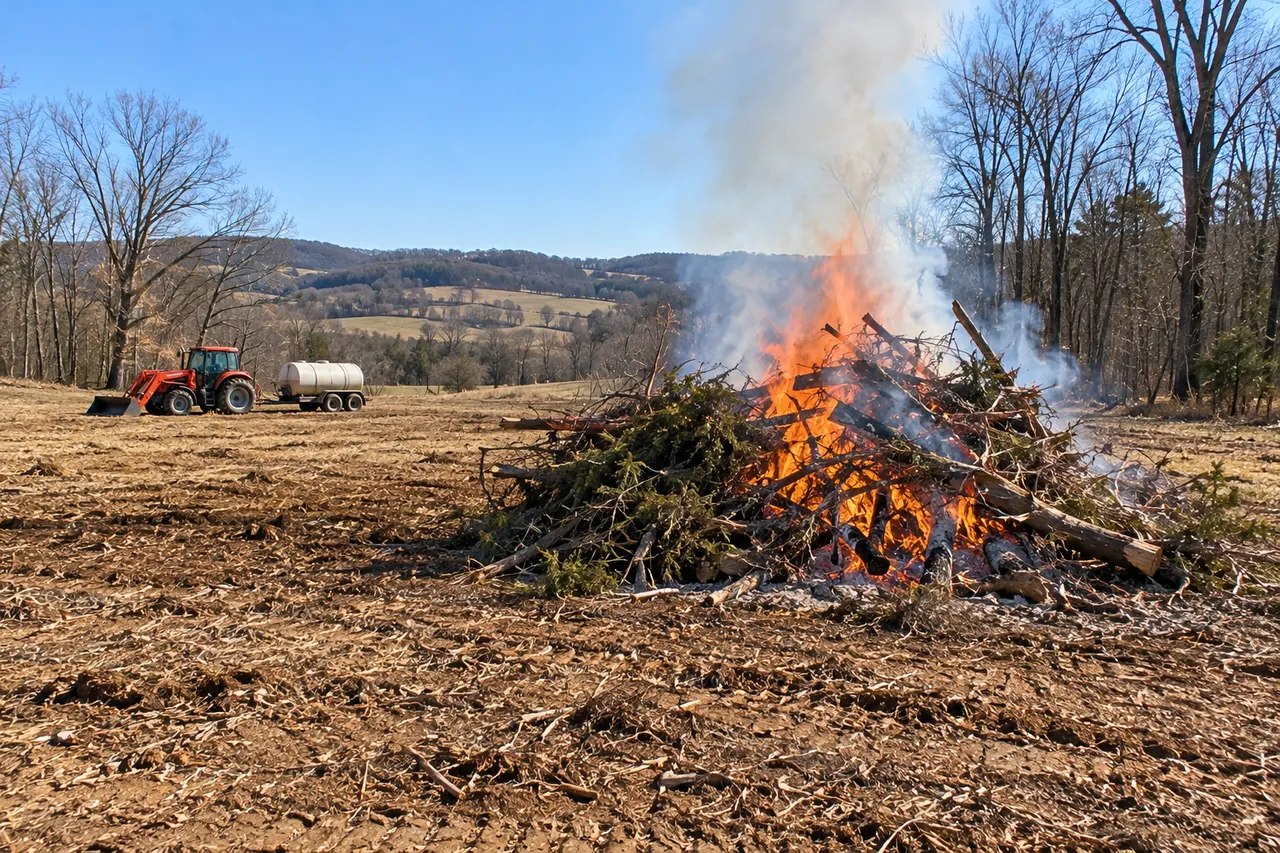
- Columbia. Open burning is generally prohibited, with an exception for "fires used to clear land consisting solely of vegetation grown on that land" for agricultural, forest, or game management purposes, with a permit. Burns run from sunrise to one hour before sunset. Apply at any Columbia Fire & Rescue station at least 48 hours ahead or online; permits are free (city burn page, 931-560-1700).
- Mount Pleasant. A permit "approved in writing by the Mount Pleasant Fire Department" is required; burns from sunrise until one hour before sunset; piles at least 50 feet from any structure (25 feet for piles no bigger than 3 feet across and 2 feet high). Call (931) 379-3939 (city page). The page doesn't cover land-clearing burns, so ask. The city council took up changes to its open-burning ordinance in July 2026, so confirm the current rules when you call.
- Spring Hill. The city's burn permit page says "Land clearing fires are prohibited," and construction debris must be hauled off. For property maintenance (not land clearing), owners of more than five acres zoned other than residential may burn brush and limbs collected on that property twice a year by permit, October 1 to May 30, at least 500 feet from a residential neighborhood and 200 feet from any forest, tree line, or combustible structure, and not in winds over 10 mph.
Septic
TDEC's septic FAQ (updated July 21, 2026) says an Environmental Scientist does a site evaluation to decide the system type. Before the visit, mark the lines and house site and mow or bush hog, but "soil disturbance, cutting and filling should not take place as part of this process." Processing can take up to 45 days, so build it into the schedule for clearing a house site. The county's subdivision regulations add that if platted soil areas "are disturbed or encroached upon," owners must get additional TDEC approvals before a building permit or certificate of occupancy. TDEC Columbia Environmental Field Office: (931) 380-3371.
Timber
Tennessee's forestry best management practices (Rule 0080-07-03-.02) say streamside management zones "should be a minimum distance of 25 feet from the disturbed area to the stream for zero percent slope," plus 20 feet for each added 10 percent of slope, on both sides. On a 20 percent slope, that's 65 feet. Near wetlands, it's at least 50 feet. TDEC's ARAP rules say the Department of Agriculture's forestry practices "should be followed," and a logging job that pollutes water because they weren't can draw a stop work order. The forestry BMP rule has no harvest notification requirement. For timber sale advice, the Division of Forestry's Find a Forester page lists who serves Maury County.
Buried utilities: Tennessee 811
Excavation, including "grading" and "digging," needs notice "at least three (3), but not more than ten (10) working days prior to beginning the work," for homeowners and contractors alike (TPUC FAQ). It's free, tickets are good for 15 calendar days after the legal start date, private lines may not be marked, and penalties can reach $15,000 per incident. Call 811 or 800-351-1111, or visit tenn811.com. Stump grinding isn't named in the rules, so ask; stump grinding and removal covers the details.
Who to call
| Question | Office (phone checked October 2026) |
|---|---|
| State construction permit, streams, sinkholes, septic | TDEC Columbia Environmental Field Office, (931) 380-3371 |
| County zoning, steep slopes, floodplain | Maury County Building & Zoning, 931-375-3002 |
| Columbia permits and trees | Columbia Development Services, 931-560-1560 |
| Mount Pleasant permits | City Hall, Building & Planning, (931) 379-7717 |
| Spring Hill permits | Development Services, (931) 451-0904 |
| State burn permits | Division of Forestry, 877-350-2876 |
| City burn permits | Columbia Fire & Rescue, 931-560-1700; Mount Pleasant Fire, (931) 379-3939 |
| Federal waters and wetlands | Army Corps of Engineers, Nashville District Regulatory, (615) 369-7500 |
| Buried utilities | Tennessee 811, 811 or 800-351-1111 |
Permit questions
Do I need a permit to clear cedar off my pasture?
Clearing for farming is generally outside the state's water permits, and Columbia exempts agricultural land management. Steep ground in the county is the open question; ask Building & Zoning. Burning the piles needs a state permit in season; Columbia allows it only for farm, forest, or game management, and Spring Hill doesn't allow land clearing fires.
Who gets the permits, me or the contractor?
It varies. The state permit goes to the site's operators, and burn permits go to whoever is burning. Put in writing who handles each one before work starts.
Can I fill a sinkhole in my field?
Not without asking TDEC first. Depending on how the land is being developed and where the water comes from, it may be a regulated injection well. Call the Columbia field office.
Can I burn in the summer?
The state permit requirement runs October 15 to May 15; outside it, the state program doesn't require one, but city rules and burn bans still apply, and Spring Hill doesn't allow land clearing fires at all. Check your city and the burn ban dashboard first.
How we help
Call or send a short request, and mention any creek, sinkhole, or steep ground. We connect you with one independent contractor who works in your part of Maury County. They walk the land and give you a quote, and you decide. There's no charge for the referral. This page is general information, not legal advice; the offices above have the final word on their rules.
Want a local contractor to walk your land?
Call or send a short request. There's no charge for the referral.