
Fence Line Clearing in Maury County, TN
Leave a fence row alone in Maury County and it turns into a strip of woods: cedar, hackberry, privet, and bush honeysuckle grown up through the wire until you can't see the fence, let alone fix it. Fence line clearing opens that strip back up, either to save the fence that's there or to make room for a new one. Here's how the work goes beside pasture and cattle, where property lines and neighbors come in, what grows back, what it costs, and the programs that can help pay for it.
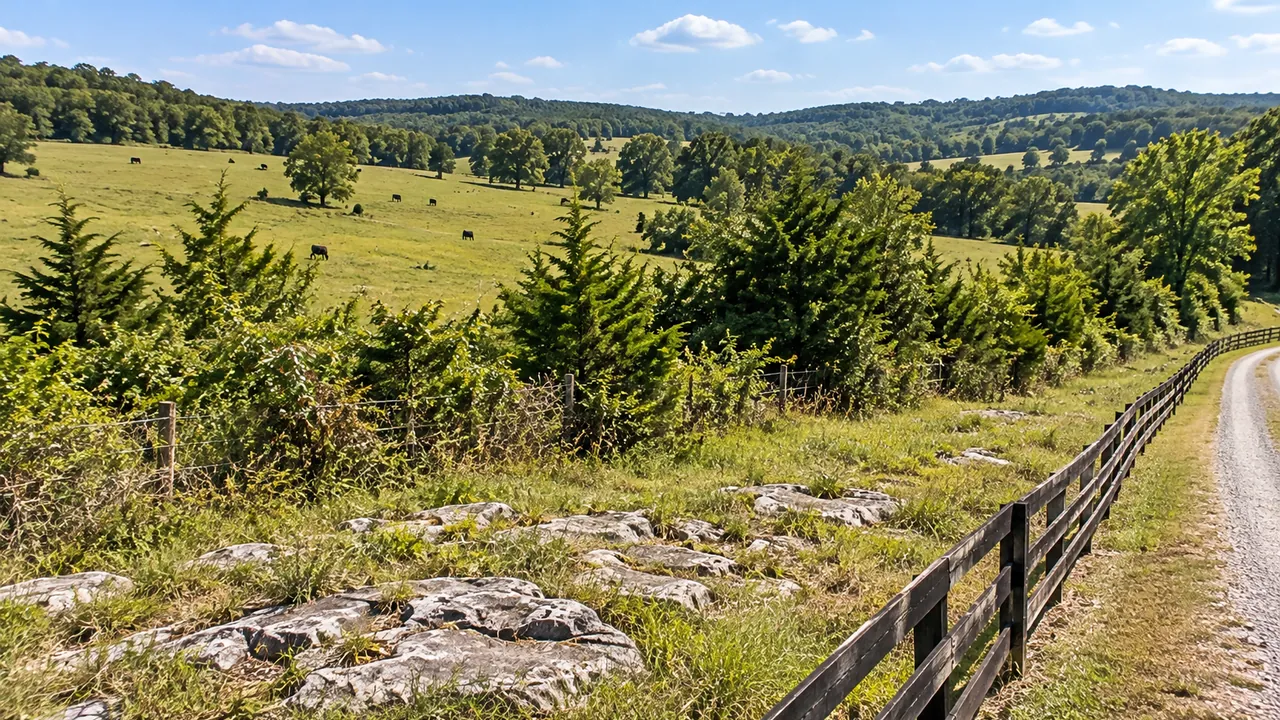
What an overgrown fence row looks like here
In Maury County's farm country, most of the woods sit on fence lines, hilltops, and creek bottoms, so a lot of the county's brush problem is fence-row brush. A row nobody has cut in years is usually eastern redcedar, hackberry, and other hardwood saplings, with Chinese privet and bush honeysuckle filling every gap underneath. The fences themselves run from three- and four-plank board fences to woven and barbed wire on wood posts, and some roads are lined with dry-laid limestone rock walls.
Saving the fence, or starting over
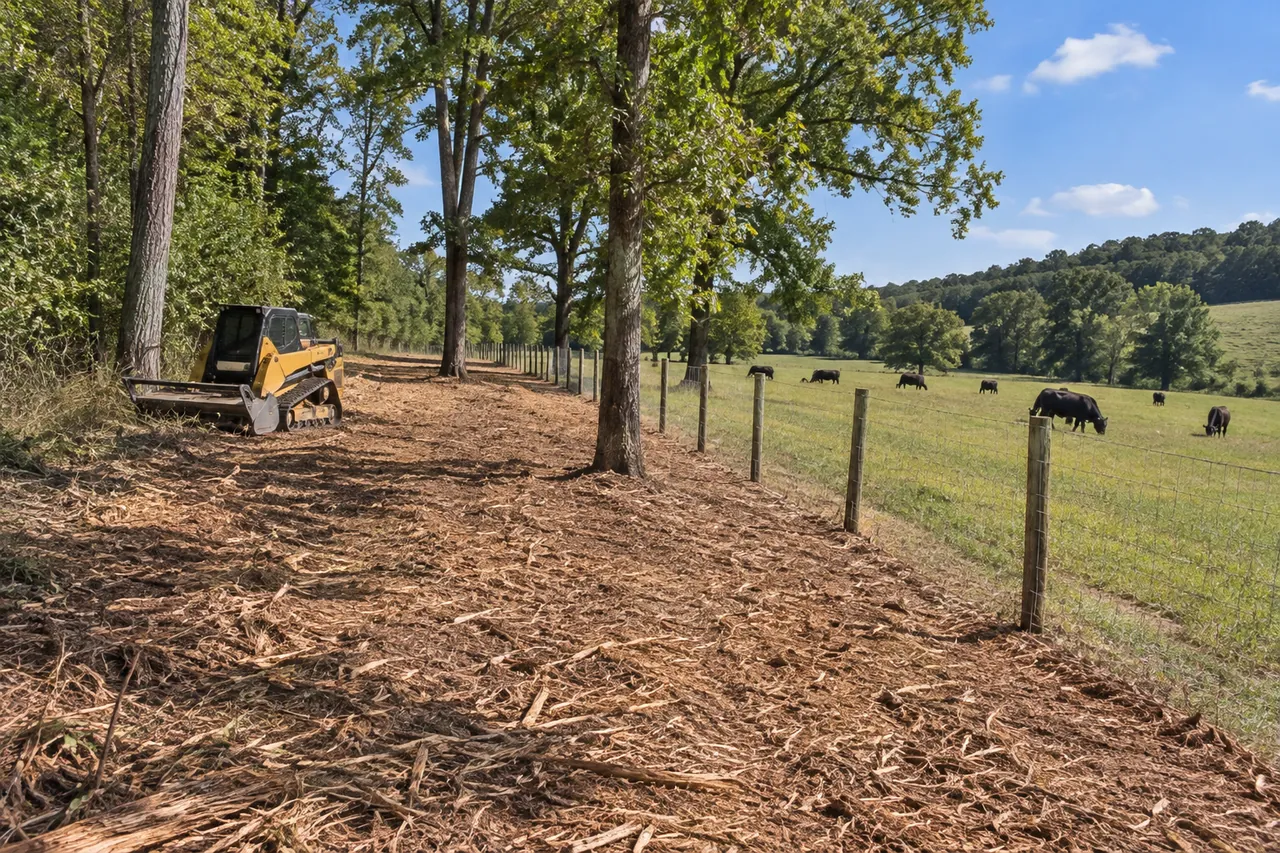
- Keeping the fence. A forestry mulcher can clear each side of the row, but a spinning head and wire don't mix, so the last couple of feet beside the fence, and any trees grown around the wire, may be saw work.
- Building new fence. The old wire and posts come out first, then the strip is cleared wide enough for the fence crew and their equipment. Stumps sitting right in the new line may need grinding or digging out so posts can go in straight.
- Stone walls. A dry-laid rock wall is easy to knock down and slow to rebuild. Point it out before the machine starts and agree how close it can work.
Settle the width up front, because it sets the price. A quarter mile of fence row (1,320 feet) cleared 15 feet wide is 19,800 square feet, a little under half an acre. A full mile at that width is 79,200 square feet, about 1.8 acres. That arithmetic is a handy check on any per-acre price, and a reason to ask whether a quote is by the job, the day, or the hour.
Property lines and neighbors
Fence rows tend to sit on or near a boundary, so some of those trees may be your neighbor's, or both of yours. Don't assume an old fence marks the deeded line. If it matters, have a surveyor mark it before the clearing starts. Deeds and recorded plats are kept by the Maury County Register of Deeds (931-375-2101). Talk with the neighbor before clearing a shared row, agree on what comes out and who pays for what, and put it in writing.
Working beside cattle
- Move the stock. Mulchers throw chips and debris, and cattle are curious. Keep them in another field while a machine works the row.
- Plan the gates. Agree on where the trailer unloads and which gates the machine uses, and who closes them.
- Keep a fence up somewhere. If the old fence comes down before the new one goes up, sort out how the cattle are held in the meantime.
- Mind the water lines. Buried lines to waterers and barns are usually private, and Tennessee 811 says private lines may not be marked. Show them to the contractor.
What grows back
The cedar won't. The U.S. Forest Service's review of eastern redcedar says it "does not sprout after complete cutting or burning." The brush underneath is a different story:
- Chinese privet sprouts from the root crown and "readily produces suckers from its extensive, shallow root system." The Forest Service's privet review warns that cutting without herbicide "will likely promote growth from sprouting," and that stems over an inch across are easiest to control by cutting low and treating the cut stumps.
- Bush honeysuckle sprouts from the root crown too. Its review says repeated cutting through the growing season "results in continued but diminished sprouting."
So a row that was mostly privet and honeysuckle needs follow-up: mowing the strip, spot-treating sprouts, or both. For herbicide choices that are safe around grazing cattle, UT Extension in Columbia (931-375-5301) is the place to ask, and always follow the label. Brush and invasive thickets goes deeper.
Call Tennessee 811 before new posts go in
The Tennessee Public Utility Commission's damage prevention FAQ defines excavation to include "auguring, backfilling, blasting, boring, digging, ditching, drilling, grading," and Tennessee 811's FAQ says the requirement "is for both professional excavators and homeowners/private property owners." Notice is due "at least three (3), but not more than ten (10) working days prior to beginning the work," the request is free, and a ticket is good for 15 calendar days after the legal start date. A homeowner's ticket doesn't cover a hired excavator, so whoever digs files their own. Call 811 or 800-351-1111, or use tenn811.com.
Cost-share for brush and fence
- NRCS and EQIP. The Brush Management practice (code 314) covers removing woody plants, including invasive ones, to improve forage for livestock. NRCS's Tennessee EQIP page shows an apply-by date of November 20, 2026. The local office is the USDA Service Center in Columbia, 931-388-1307, ext. 3; call before going.
- TAEP. The Tennessee Department of Agriculture's Agricultural Enhancement Program raised its 2025–2026 maximum for "Working Structures & Fence-line Systems" from $4,000 to $5,000. The October 1–7, 2026 window has closed; TAEP applications open once a year in early October, so watch for the next one. Whether any clearing counts toward a fence-line project, and the cost-share percentages, are questions for the program.
What fence line clearing costs
Long, narrow jobs don't fit per-acre figures well, so hourly rates are the more useful benchmark. HomeAdvisor's June 2026 guide lists forestry mulching at $200 to $400 an hour for heavy, dense brush, and $125 to $200 for lighter underbrush and small trees. Angi's September 2026 guide says land clearing pros typically charge $110 to $250 an hour. For example, if a contractor estimates two days (16 hours) for a half mile of thick row, HomeAdvisor's heavy-brush range comes to $3,200 to $6,400. The hours are the assumption.
What moves the number: how thick and tall the row is, wire to work around, rock, tearing out old fence, hauling or burning instead of mulching, slope, and the trip charge. These are national figures, not Maury County prices. The written quote from a contractor who has walked the row is the number that counts. More on cost.
Fence line questions
Can the old fence stay up while the row is cleared?
It can, with care and some hand work next to the wire. Tell the contractor up front, because it's slower than clearing a line where the fence is coming out anyway.
When's a good time of year?
Late fall and winter make the job easy to see: the hardwoods are bare and the cedar and honeysuckle are the main green. More important is picking a stretch when the cattle can stay in another field.
Can the brush be burned?
In rural Maury County, from October 15 through May 15, a free Division of Forestry permit is required for an open-air fire within 500 feet of woods or grassland. City rules differ, and Spring Hill's burn pages say land clearing fires are prohibited. The permits guide has each one.
Do I need a permit to clear a fence row?
Tennessee's water rules treat farm work differently from construction. If the line crosses a creek, though, ask the TDEC Columbia Environmental Field Office, (931) 380-3371, before a machine works in the channel. Physical changes to a stream generally need an Aquatic Resource Alteration Permit, and whether a farm exemption applies is TDEC's call.
How we help
Call or send a short request: about how long the fence rows are, what's growing in them, and whether the fence stays or goes. We connect you with one independent contractor who clears fence lines in your part of Maury County. They walk the rows and give you a quote, and you decide. There's no charge for the referral.
Want a local contractor to walk your land?
Call or send a short request. There's no charge for the referral.